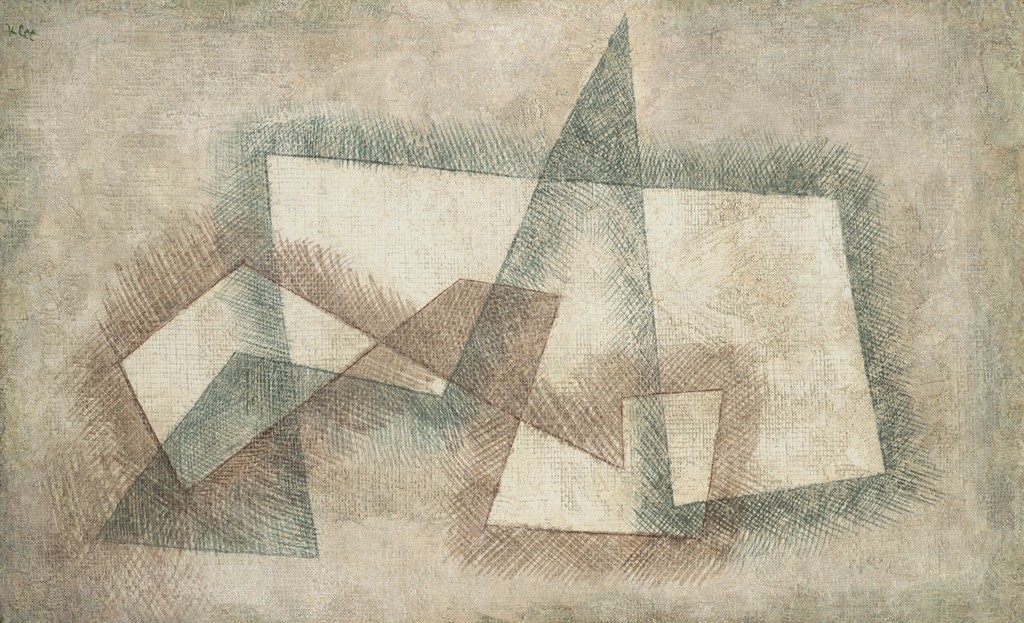
Paul Klee, Abstract composition with greys, blues and browns, 1923
“All pictorial form begins with the point that sets itself in motion…
The point moves . . . and the line comes into being—the first dimension.
If the line shifts to form a plane, we obtain a two-dimensional element.
In the movement from plane to spaces, the clash of planes gives rise to
body (three-dimensional) . . . A summary of the kinetic energies
which move the point into a line, the line into a plane,
and the plane into a spatial dimension.”
Paul Klee
The Thinking Eye: The Notebooks of Paul Klee
(English translation)
1961
Here are the slides from the Form and Space Lecture:
In the first two chapters of our text for this course, we will be exploring the primary elements that make up three dimensional space. By breaking down the fundamental geometry, one can begin to see how each move in a composition begins to work together to form the whole. When reading, always try to imagine how the diagrammed spaces and drawings might feel to inhabit. Try to pay attention to your intuitive reactions to the forms as you see them. Sketch the forms and write your thoughts using your sketchbook to take notes.
Ching, Francis DK. Architecture: Form, Space, Order, Chapter 1-Primary Elements
Ching, Francis DK, Architecture: Form, Space, Order- Chapter 2- Form Primary Elements
Architecture Form, Space, Order by Francis D. K. Ching (z-lib.org).pdf
This is a quick text on design "actions" as they relate to making a Mass. This text is helpful as a catalog of verbs to describe what an architect might do to create a mass or form. These verbs are helpful for moving beyond platonic forms to describe more contemporary volumes. Try to pay attention to your intuitive reactions to the forms as you see them. Sketch the forms and write your thoughts using your sketchbook to take notes.
DiMari, Yoo. Operative Design: A Catalogue of Spatial Verbs, 2012
Here is a short sample of the book in PDF form Operative Design Issuu.pdf
OPERATIVE_DESIGN_A_Catalog_of_Spatial_Verbs.pdf
A Note on Readings:
Technically the deadline for readings is at the end of each module when you will be completing your module quiz. However, I strongly suggest you read a bit at a time to not get overwhelmed and to be better prepared for class time and reviews. Since concepts will be covered toward the beginning of the module, it is best if you can complete the reading during the first week of each module.